Krakatoa Eruption Disrupts Thousands Of Flights – But Could A Bigger Eruption Affect The Whole World?
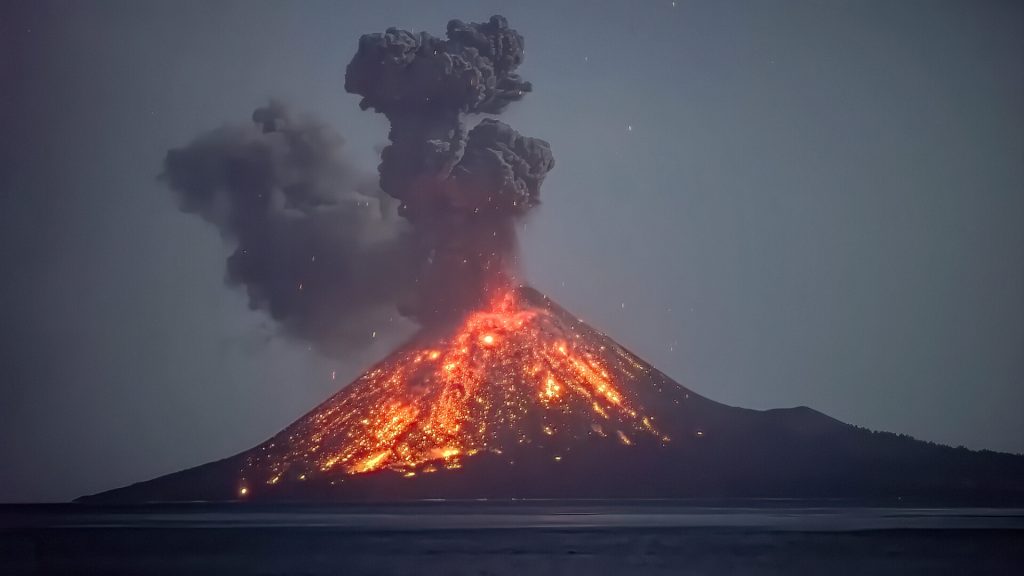
Night-time eruption of the Anak Krakatoa or Anak Krakatau volcano in 2018. Indonesia
One of the world’s most infamous volcanoes has erupted again – and this time the consequences are being felt far beyond the immediate area around the crater.
Above: Footage from Associated Press
Indonesia’s Anak Krakatau – the “Child of Krakatoa” that emerged from the remains of the volcanic system responsible for the catastrophic 1883 eruption – underwent an extraordinary period of activity over the weekend, sending volcanic ash high into the atmosphere and causing widespread disruption to air travel.
By Monday, September 7, the eruption had affected more than 2,300 flights and disrupted the journeys of more than 270,000 passengers, according to Reuters.
Seven Indonesian airports remained closed on Monday morning, including Jakarta’s two airports, as volcanic ash continued to make flying potentially dangerous.
Jakarta’s main Soekarno-Hatta International Airport was expected to remain closed until at least 6pm local time on Monday as authorities continued to assess ash concentrations and changing wind conditions.
The disruption has turned what began as a spectacular volcanic event in the Sunda Strait into an international travel crisis.
And although the particularly intense continuous eruption has now ended, Indonesian scientists are warning that Anak Krakatau remains highly active and could erupt again.
It raises a much bigger and more unsettling question.
If Krakatoa can already disrupt hundreds of thousands of journeys, what would happen if the volcano produced another truly enormous eruption?
More Than 270,000 Passengers Affected
The immediate international consequence of the latest eruption has been aviation disruption.
Volcanic ash is extremely hazardous to aircraft. Fine particles can damage windscreens and other components and, critically, can be drawn into jet engines, where they can melt before solidifying inside the engine.
As a result, airlines generally avoid flying through known volcanic ash clouds.
The latest activity at Anak Krakatau sent ash to extraordinary heights. During the most powerful phase, ash was reported at altitudes of up to around 50,000 feet – well above the cruising altitude of most commercial aircraft.
Flights were suspended at airports across western Indonesia, including Soekarno-Hatta and Halim Perdanakusuma in Jakarta.
International routes have also been affected, with airlines including Singapore Airlines, AirAsia, Qantas and others cancelling, diverting or rescheduling services.
Flights linking Indonesia with destinations including Singapore, Kuala Lumpur, Sydney, Doha and other international hubs have been caught up in the disruption.
Airlines are continuing to monitor volcanic ash forecasts closely, meaning further cancellations and delays remain possible even as the most intense phase of the eruption subsides.
Passengers planning to travel to, from or through Indonesia are consequently being advised to check directly with their airline before travelling to the airport.
What Is Happening At Anak Krakatau Now?
There has at least been some encouraging news from Indonesia’s Geological Agency.
Officials confirmed on Monday that the extraordinary continuous eruptive episode has ended.
According to the agency, the episode began at 11.07pm local time on Friday, September 4 and finally ended at 12.04am on Sunday, September 6 – meaning the volcano was in a continuous eruptive phase for around 25 hours.
Activity has subsequently returned to a more characteristic Strombolian pattern, involving intermittent explosive eruptions.
Seismic measurements have also shown some decline from the exceptional activity recorded on Saturday.
That does not, however, mean the eruption is over.
Indonesia’s Geological Agency says the possibility of further eruptions remains high.
Between September 6 and 7, monitoring equipment recorded three eruption earthquakes, nine emission earthquakes, 93 low-frequency earthquakes, 98 hybrid or multi-phase earthquakes, four continuous tremor events and one shallow volcanic earthquake.
The volcano therefore remains at Level III – Siaga, or Alert, one level below Indonesia’s highest volcanic warning status.
The public, tourists and climbers have been instructed to remain at least three kilometres from the active crater.
Why Volcanic Ash Is Still Causing Problems
The eruption easing does not automatically mean airports can reopen.
Once volcanic ash enters the atmosphere, its movement is heavily influenced by wind direction, altitude and weather conditions.
That means ash produced hours earlier can continue moving through important aviation corridors long after an explosive eruption has subsided.
Authorities have detected ash in airspace surrounding Jakarta and other parts of western Indonesia, forcing airports and airlines to take an extremely cautious approach.
Indonesia’s transport authorities have also warned that conditions remain unpredictable because changing winds can move volcanic ash into areas that had previously appeared clear.
Aircraft may additionally require inspections before returning to service if there is any concern that they have been exposed to ash.
The Indonesian government has even been using weather-modification measures intended to encourage rainfall and help clear volcanic ash from affected areas.
Schools in some affected areas have switched to remote learning, while residents have been advised to wear masks outdoors because volcanic ash can irritate the eyes, skin and respiratory system.
For travellers, the message is therefore clear: even if Anak Krakatau becomes quieter, disruption could continue while ash remains in important flight paths.
When Krakatoa Changed The World
The sight of Anak Krakatau erupting inevitably carries particular significance because of what happened here 143 years ago.
On August 27, 1883, Krakatoa produced one of the most famous volcanic catastrophes in recorded history.
The eruption was rated at Volcanic Explosivity Index 6, destroyed much of the volcanic island and generated devastating tsunamis. More than 36,000 people died.
But Krakatoa’s influence didn’t stop at Indonesia’s coastline.
The explosion sent enormous quantities of ash and sulphur compounds high into the atmosphere. Atmospheric pressure waves travelled around the planet, while volcanic material produced extraordinary optical effects thousands of miles from Indonesia.
The 1883 eruption is estimated to have lowered global average temperatures by around 0.5C to 0.6C temporarily.
Fine particles and aerosols high in the atmosphere also produced spectacular sunsets around the world.
Scientific research has subsequently demonstrated that sufficiently large volcanic eruptions can affect global temperatures for several years.
And the crucial ingredient isn’t simply ash.
It is sulphur.
Could A Volcano In Indonesia Change British Weather?
A sufficiently large explosive eruption can propel enormous quantities of sulphur dioxide into the stratosphere.
There it reacts to produce tiny sulphate aerosol particles.
These particles reflect some incoming solar radiation back into space, reducing the amount of energy reaching the Earth’s surface and producing temporary cooling.
Krakatoa’s location makes this particularly significant.
Because the volcano lies in the tropics, material injected sufficiently high into the stratosphere can potentially circulate into both the Northern and Southern hemispheres.
A genuinely enormous eruption in Indonesia could therefore eventually influence weather and climate thousands of miles away, including in Europe.
That would not mean Britain suddenly being buried beneath Indonesian volcanic ash.
The climatic effects would be considerably subtler.
Average temperatures could temporarily fall, rainfall patterns could change and large-scale atmospheric circulation could be altered.
Major tropical eruptions can produce short-term reductions in UK temperatures, although their impact on rainfall and individual seasons is considerably harder to predict.
Paradoxically, volcanic cooling does not necessarily make every location colder during every season. Changes to atmospheric circulation can sometimes produce warmer winter conditions in parts of Europe even while average global temperatures decline.
Could Krakatoa Temporarily Slow Global Warming?
Technically, yes – but only temporarily, and only following a vastly larger eruption than ordinary volcanic activity.
The 1991 eruption of Mount Pinatubo in the Philippines provides one of the best modern examples.
Pinatubo injected enormous quantities of sulphur dioxide into the stratosphere and was followed by a measurable reduction in global temperatures.
But volcanic cooling is temporary.
Sulphate aerosols gradually disappear from the atmosphere, removing their cooling influence.
Carbon dioxide released through human activity remains in the climate system for vastly longer.
A giant eruption therefore wouldn’t “cancel” climate change.
At most, it could temporarily mask part of the warming trend before temperatures subsequently rebounded.
Food Could Be A Bigger Concern Than Cold Weather
Perhaps one of the most underestimated consequences of an enormous volcanic eruption is its potential impact on agriculture.
Modern civilisation depends upon vast and highly interconnected food-production systems.
Changes in temperature, rainfall and the amount of sunlight reaching crops can affect harvests across major agricultural regions.
The extreme historical example is Indonesia’s Mount Tambora eruption of 1815, which was substantially larger than Krakatoa.
The following year became known across parts of Europe and North America as the “Year Without a Summer”.
Abnormally cold and wet conditions contributed to crop failures, food shortages and soaring prices.
Were something comparable to happen today, the economic consequences could potentially spread around the world extraordinarily quickly.
More than eight billion people now depend upon interconnected agricultural, transport, energy and financial systems.
Simultaneous poor harvests across several major food-producing countries could push up wheat, maize and other commodity prices thousands of miles from the volcano responsible.
A giant Indonesian eruption could therefore become an economic crisis in London, New York and Brussels as well as a natural disaster in Southeast Asia.
What About A Tsunami?
For communities around the Sunda Strait, another question inevitably arises whenever Anak Krakatau becomes highly active.
Could it produce another tsunami?
Anak Krakatau has already demonstrated that it does not require an 1883-scale explosion to generate one.
On December 22, 2018, part of the volcano’s flank collapsed into the sea during an eruption.
The sudden displacement of water generated a tsunami that struck the coasts of Java and Sumatra, killing more than 400 people.
Unlike earthquake-generated tsunamis, volcanic landslide tsunamis can be particularly difficult to detect because they do not necessarily produce the powerful earthquake signals normally used by warning systems.
However, Indonesian disaster authorities have stressed that there is currently no immediate indication of a comparable tsunami threat from the latest eruption.
The volcanic structure that has rebuilt since the 2018 collapse remains relatively small, reducing the likelihood of a collapse on the same scale.
Residents around Banten and Lampung have nevertheless been urged to remain vigilant and follow official advice rather than rumours circulating on social media.
Is This Becoming Another 1883 Krakatoa Eruption?
There is currently no evidence that it is.
That distinction is extremely important.
Anak Krakatau is unquestionably dangerous. The events of the past few days have demonstrated that clearly.
Ash has climbed into commercial aviation altitudes, airports have closed, thousands of flights have been disrupted and hundreds of thousands of passengers have had their journeys affected.
But there remains an enormous difference between a serious volcanic eruption capable of causing major regional disruption and a VEI-6 event capable of altering the global climate.
For an eruption to become a worldwide climatic event, it generally needs to inject enormous quantities of sulphur dioxide high into the stratosphere.
There is presently no evidence from Indonesian authorities that Anak Krakatau is approaching anything comparable to the catastrophic 1883 eruption.
The Immediate Danger Is Real – The Global Catastrophe Remains Hypothetical
For now, the most important consequences are regional rather than global.
Volcanic ash continues to threaten aviation. Airports and airlines are dealing with an enormous backlog of disrupted passengers. Communities are coping with ashfall, schools have been affected and authorities continue monitoring the volcano for another explosive episode.
The fact that the 25-hour continuous eruption has ended is encouraging.
The fact that scientists believe further eruptions remain possible means the story is far from over.
For the rest of the world, Anak Krakatau provides a remarkable reminder of how quickly geological events in one relatively small corner of Indonesia can affect modern international infrastructure.
A volcano sitting in the Sunda Strait has already disrupted the journeys of more than a quarter of a million people.
In 1883, Krakatoa demonstrated something considerably more dramatic: that a sufficiently powerful eruption could send atmospheric effects around the entire planet.
There is no evidence that history is repeating itself on that scale in September 2026. But with Anak Krakatau still at Level III, further eruptions considered likely and volcanic ash continuing to disrupt international aviation, Krakatoa is once again a volcano the world is watching very carefully.
—